Thursday, July 15, 2021

Heroes of the Lost Age: Night Man


 Hello and welcome to the second edition of Heroes of the Lost Age!


Our new lost hero explored is...Night Man!


Night Man made his comics debut in The Strangers #1 and Night Man #1, created by Steve Englehart and Rick Hoberg in 1993 as a part of the Ultraverse imprint of Malibu Comics. What's the story you ask? Night Man is about Johnny Domino/Domingo, a jazz musician operating in the Bay Area, until a cosmic event called "The Jumpstart" endowed him with the power to hear evil thoughts of others around him, and to see in the dark. At the cost of his ability to sleep.

Armed with this new ability, Domino put together a costume to fight criminals as the Night Man.

The character has undergone certain changes as to his powers and development. In the second relaunch of the comic book series, Night Man had his powers altered by Rhiannon, enabling him to see a dark aura around people, generate lightning from his hands, fade into the darkness for stealth, and being mentally linked to a dagger that was bestowed upon him by Rhiannon which he can sense from a distance and cut portals in the air for teleportation. But Rhiannon's gift came with a cost, Night Man must consume a broth of human organs in order to survive.

In 1995, Night Man made his TV debut in the old Ultraforce cartoon. In the episode "Night and the Night Man", his origin is told in the same fashion as the comic book. When Johnny is turned into an Ultra like others involved in the accident, team members Hardcase and Contrary try to recruit him to their ranks as their adversary Chrysalis terrorizes San Francisco.


Though it was declared official Malibu Comics had fallen by their being purchased by Marvel Comics in 1995, Night Man would make his presence felt once more in a live action TV series starring Matt McColm as the title character from 1997 to 1999. The series was created by Glen A. Larson.

In contrast to the comic book incarnation, Night Man's origin is told differently as to not being called an "Ultra." He's struck by a bolt of lightning in a freak cable car accident which gives him his powers. Although he battles a different villain in each episode, Night Man's arch enemy is computer billionaire Kieran Keyes (Kim Coates) who would kill his father in the premiere of the second and final season.

The TV version of Night Man is painted in a different light. Instead of a makeshift costume he put together himself, a tech wizard gives him a bulletproof body suit which enables him to fly with an anti-gravity belt, a camouflage invisibility mechanism, and advanced sight functions in the lens over the left eye of his mask that allows him to fire a laser beam. Like his comic incarnation, this Night Man could see in the dark. 

In retrospect, Night Man appealed to me in my youth. Being a superhero fan I didn't care how the TV show looked since I enjoyed Spider-Man, Batman, and X-Men when they had their own animated series respectively. What fascinated me about him was how he's different from the others. He's a musician playing a mean saxophone. And though Night Man possesses a telepathic power, he's trained in aikido which he utilizes in his endeavors to make him a grounded character. With the Ultraverse in the hands of the House of Ideas, those who remember the characters like Johnny/Night Man should hope for a comeback from limbo. 

That's all for our Heroes of the Lost Age! Tune in next time!


Saturday, July 3, 2021

Heroes of the Lost Age: M.A.N.T.I.S

 Hi, everyone.

Welcome to the first of my blog segment called Heroes of the Lost Age! Here I will explore forgotten heroes of days past that have been on TV and other media. First up is Sam Raimi's M.A.N.T.I.S.

M.A.N.T.I.S was a TV series which aired from 1994-1995, starring Carl Lumbly as Dr. Miles Hawkins/M.A.N.T.I.S, created by Sam Raimi and Sam Hamm.

The story behind M.A.N.T.I.S is Dr. Hawkins was shot in the spine by a police sniper during a riot, leaving him paralyzed from the waist down. Filing a lawsuit against the cop he held responsible and lost, Miles discovers a conspiracy that's launched against the colored community which he directs his focus on by pouring his resources into creating an exoskeleton and a black bulletproof body armor that endows him with super strength and the ability to walk. And thus M.A.N.T.I.S was born. The acronym means Mechanically Augumented Neuro Transmitter Interception System. In the series it was renamed Mechanically Augumented Neuro Transmitter Interactive System.

M.A.N.T.I.S powers and weapons are reminiscent of Batman in regards to being smart and wealthy. For instance, he has no powers. Only his exoskeleton which is armed with non-lethal paralyzing darts and super strength. His hidden underwater lab underneath his seaside mansion is called the Seapod and his vehicle of choice is a flying car/submarine which is dubbed the Chrysalis.


In the TV movie pilot, there were strong roles for African American actors including Bobby Hosea, Steve James, and future Firefly alumn Gina Torres. When the M.A.N.T.I.S series premiered, recasts were done except for Lumbly's character. The series casted the late Roger Rees as John Stonebrake, a british scientist who helped Hawkins create the exoskeleton, Christopher Gartin as the mouthy-street wise Taylor Savage/Savidge, and Galyn Gorg as Lt. Leora Maxwell.

There were a few changes to the character and the series such as the location of the show. Production of the pilot was set in Los Angeles as the series was set in Vancouver, British Columbia, Canada. The changes in the M.A.N.T.I.S himself were such as him wearing a stylish suit and trench coat over his exoskeleton minus a skull cap and leaving little metal praying mantises as his calling card.

Though the concept was an entertaining one at that, but unfortunately poor ratings and constant retooling of the show was its downfall. One thing is for sure Sam Raimi's creation of TV's first prime time superhero of color had paved the way for Luke Cage and Black Lightning.

And that's the first part of Heroes of the Lost Age. Be there as we explore more forgotten heroes, chaps!  


Tuesday, May 4, 2021

The Three Act Structure

For most stories they are split in to three parts. The first, second, and third act. The three act structure has twists, turns, and specific moments in which certain things should be unfolding at certain times. Moreover, it's an organizational tool to help build your story.

**Aristotle stated that dramas have a beginning, a middle, and an end. Really cool since the Greeks invented drama. Screenwriters get much more detailed with requirements of what goes into three acts of a movie. The key takeaway is understanding that one event in the story goes into another event which unifies actions and creates the semblance of a story.

For a general idea of the three act structure, let's take a look at the essential parts, shall we? Here's a breakdown on Thunderbolts #26 from 1999 entitled "Lockdown."

First act-Introduction of the cast of characters.

Second act-Prison riot; Rhino breaks free.

Third act-MACH 1 stops riot. Then his actions are found out by the CSA (Commission on Superhuman Activities).

Neat, yeah? 

*Comics' legend Peter David pointed out that Aristotle's simple observations of beginning, middle, and end have been codified, institutionalized, or mummified. Editors, producers, etc, will be analyzing your story frequently based on whether they see the beats of the three act structure present. It will be helpful to know what they're looking for so you can be sure to accommodate them.

My Writing Challenge colleague Emily Moore will agree with the notion that we're dealing with a structure, not a formula. A formula results in a sameness that makes everything seem overly familiar and predictable. And she'll mention how films like Candyman hinges on the three act structure which will differentiate itself from other motion pictures.

Now we go in-depth into the three act structure. For research, I did an analysis of the Gundam: The 08th MS Team episode "Gundams in the Jungle."

First Act-Introduction of the team. Here in the first act of the episode, we meet the 08th Mobile Suit team (Ensign Shiro Amada, Michel Ninorich, Karen Joshua, Terry Sanders, and Eledore Massis). They are on their way to base for their first mission under ensign Shiro's command. Being introduced also is Commander Kojima who briefs the team on a Zeon base built somewhere in the jungle.

First act turning point-After a brief scrimmage with Zeon forces in the jungle, Shiro gets separated from the rest of the unit by going after the damaged Zaku drone.

Second act-The middle of the story. Ensign Shiro is hot on the trail of the Zaku but he ends up getting lost in the jungle (For the record, I say it's his damn fault for running off like that). Then he stumbles upon fresh water coming from a waterfall, where he encounters Kiki Rosita of the guerrila resistance. 

Second act turning point-Elsewhere from the action, Aina Sahalin is having tea & biscuits with her brother, the rear admiral Ginias Sahalin. They're discussing her brother's "dream" would soon become a reality, hinting of a weapon that will tip the balance of power in favor of the Zeon.

Third act-It's round two of Shiro vs the Zaku. 

Climax-Shiro unloads everything at the Zaku, defeating it. With their mission over, the MS team returns to base. Shrio sleeping in the cockpit while his Gundam was on autopilot ended the episode on a lighter note.

Whether you're writing a script for a movie or a comic, most stories in between those genres, hinge on the three act structure. 

Happy Creations!

Sources: *Writing for Comics & Graphic Novels with Peter David pg. 98

**Alyssa Maio. "What is the Three Act Structure in Film? No Formulas Necessary." https://www.studiobinder.com/blog/three-act-structure/


Saturday, February 20, 2021

The Darkest Reflections

We have always done the same kind of work. Our methods have not differed as much as you pretend. I am a shadowy reflection of you. But it would have taken only a nudge to make you the same as me, to push you out of the light.
-Indiana Jones and the Raiders of the Lost Ark (1981)

The hero won't be spending all his or her time at odds with other members of their supporting cast. Heroes need their villains because one side helps define the other. The best sort of hero/villain throw downs are those in which the villain, using his power, abilities, origin, personality, or some combination of the four, provides a direct contrast to the hero. He is the hero gone wrong, the hero who is sent off the deep end.

*Comics legend Peter David states that it's the same as the heroes and their arch-enemies. More often than not, they both work at the outer edges of the law. In the old days, the main way to tell the good guys from the bad guys was that the former would refrain from delivering the coup de grace. With the likes of the Punisher and Red Hood (Jason Todd), that line of demarcation has been erased. When the good guys throw punches with the bad guys, like as not, they're trying to put down their opposite numbers.

Recalling on internal conflict, the hero has to not only battle external forces but the darkness within himself. If man vs. himself is done properly, the villain in some measure, reflects aspects of the hero that the hero would rather not address. In working to defeat the enemy, the hero is battling his own darkest impulses.

A prime example of the contrast is Incredible Hulk: Future Imperfect which puts the Hulk in a literal battle against a future version of himself called the Maestro who ruled a distant future with an iron fist. Peter David and George Perez took readers on a psychological trip in the second half of the book when the Maestro tried to bring the Hulk over to his way of thinking. What made the conflict so daunting for the Hulk was that he knew the potential of becoming the Maestro was deep within him. 

*David says not every villain needs to be an exact reflection of the hero. But he shouldn't be interchangeable with someone else's opponent, either. Both in terms of power and personality level, he should tie in thematically with the hero so that he is unique to the hero he opposes.

Take Mr. Fantastic and Doctor Doom for instance. Both are extraordinary scientific minds and explorers who seriously botched their endeavors which had taken different directions. Richards brought Ben Grimm, Susan Storm, and her brother Johnny on a space expedition that exposed them to cosmic rays thus spawning the Fantastic Four. However, Reed ignored Ben's cautions about sufficient shielding to keep the cosmic rays out of their craft. Victor Von Doom was conducting an experiment to communicate with a another dimension. But for his troubles, the experiment went sideways and it blew up, leaving him disfigured. Of all the twisted aspects of Doctor Doom is that he blames Richards for the miscalculations of his experiment.

In writing battles of good vs. evil, we should think how the villain is a contrast to the hero.

Happy Creations! 

*Writing for Comics & Graphic Novels with Peter David pg. 86


Saturday, January 23, 2021

Tools for Writing Comics Pt. 1

Hello, world!

I'd like to welcome you to the first part of my Tools for Writing Comics series.

I present to you three guides by the industry's brightest minds: Peter David, Alan Moore and Brian Michael Bendis.


First up is Writing for Comics & Graphic Novels with Peter David. What I found interesting is David's approach to writing comics how he's providing helpful insight as well his own personal yet funny anecdotes from his storied career in comics. [Peter] David's book also has advice on how to create your own comics from the essentials of character development, plot and pacing, scripting format, and an updated chapter on how to break in to the comics game by Andy Schmidt. The best part of this book are the writing prompts which helped me with original story ideas as I dove in to writing my own projects.

Second is Alan Moore's Writing for Comics. I've only heard of Alan Moore through works like Watchmen, V for Vendetta, and his work on Swamp Thing. I first picked up this book looking for sources on writing years ago. Another thing was to see what Moore had to offer on the craft. His way differs from others because he's narrating through an essay he wrote in 1985 on how to write a great script. In the reprinted edition, Moore teams up with artist Jacen Burrows and adds a bonus essay on how the writer should not be afraid to try new styles circa 2003. On the same level of Peter David's book, he gives an honest perspective on writing for comics.

Finally, we get down to...Words for Pictures by Brian Michael Bendis!
In my opinion, Bendis gives a very deep look in to the comics business. He shares the process of writing script formats to sequential art and more. The book also features insights from industry legends and glossary for business terms in writing for comics. What Bendis gives in detail is how to build relationships with the creative teams on a project. Added with his own experiences in the business, Brian Michael Bendis lays out the best advice for all writers: Write truthful and honest. 


For my overall review, these books have pointed out a clear and concise view on how to not only write for comics but also how to thrive in the industry, making connections and how to build solid ones as one goes into comics & graphic novels. To anyone looking for resources on writing for comic books, I recommend these works from the legends themselves.

Happy Creations!


Thursday, January 9, 2020

Reflections

Happy New Year, world! We made it to the next decade of the new millennium!

Now I haven't been on a blogging groove like I have but I want to let you cats know it's all good. 2019 has been a TRIP for me and I've been very reflective on how things had turned out. So here's a quick recap of what went down on my end of the last year of the 2010s.


  • My first Women's March
  • Open Mic Poetry
  • Being terminated from my old job after four years
  • Starting a new job with the developmentally disabled
  • My first poetry publication in four years
I'd give the details for each of these life events of yours truly but it would be too long to go through so that's my recap of 2019.

Be there as I get back in the swing of things in 2020!

See ya!

Friday, December 13, 2019

Stay Tuned!

I don't have any topics to blog about today. This is me getting my thoughts out.

These past five months have been a roller coaster. Things are changing so fast before I could even blink. I can't think of any place to start so I'm tapped out.

What I can say is I'm doing okay and ya boy needs a time out.

Stay tuned, cats!

Thursday, August 8, 2019

Folklore Thursday: The Wild Hunt

Hello everyone and welcome to another edition of Folklore Thursday.

Today we travel to Europe exploring another one of its legendary histories. The Wild Hunt.

*The Wild Hunt is a folklore motif that historically occurs in European folklore, typically involve a ghostly or supernatural group of hunters passing in wild pursuit. The hunters may be either elves, fairies, or the dead.

*In according to legends, the Wild Hunt has had many different leaders. Most notable ones are Odin or Woton, Berchta, Arthur, and Gywn ap Nudd. Others names are biblical figures such as Cain, Herod, Gabriel, or the Devil.

AsgÃ¥rdsreien [The Wild Hunt of Odin] (1872) by Peter Nicolai Arbo
  *Seeing the Wild Hunt was thought to presage some catastrophe such as war or plague, death to those who witness the Hunt. *Experts in conclusion to the body of the lore surrounding the Wild Hunt finds a number of themes that connect powerfully to the dead and the underworld.

That's a wrap for this week's folklore exploration, friends! Tune in next week!

*Source(s): Wikipedia/Wild Hunt
*norse-mythology.org/the-wild-hunt/
*Encyclopedia Mythica

Thursday, July 18, 2019

Folklore Thursday: Basilisk

And we're back with this week's Folklore Thursday.

Today we explore one of the most vicious and terrifying serpents in legends, the basilisk!

*In European legends, a basilisk is mythical beast reputed to be a serpent king, which is a hybrid from a rooster and a serpent. A single glance from the beast can cause death. Other accounts say that it leaves deadly poison in its wake and spits venom. *Another name for the basilisk is a cockatrice.

*The Naturalis Historia of Piny the Elder says the basilisk can be killed by the odor of the weasel, which according to Piny, was thrown into the basilisk's hole, recognizable because of the surrounding shrubs and grass was scorched by its presence.

And that's it for this week's folklore figure on this Thursday, friends. Until next time!

*Source(s): Wikipedia & Encyclopedia Mythica


Thursday, July 11, 2019

Folklore Thursday: Kelpie

Happy Thursday all folklore aficionados!

Welcome to my latest edition of Folklore Thursday! Each week I will give the rundown on the legendary, the weird, and the scary.

Today, we're exploring the Scottish parts of mythology with...the kelpie!

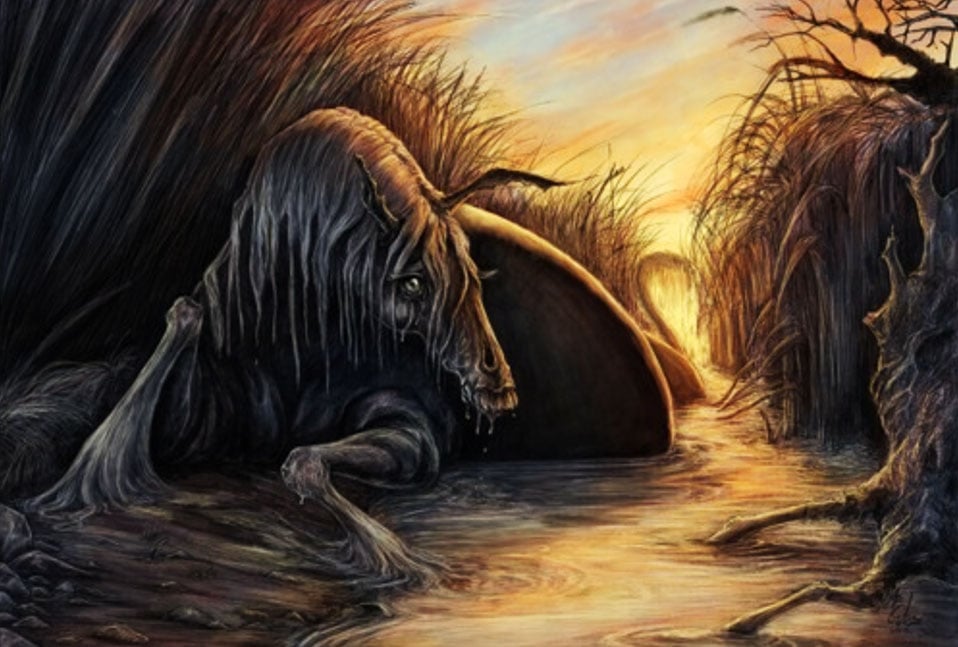
*In according to Encyclopedia Mythica, the kelpie is a water spirit that lurks in rivers and streams. It usually assumes the form of a black horse and entices people to mount it. Then rushes off to its watery lair taking the victim with it. Another account says they have the power to assume human form while keeping its hooves.

The kelpie can also cause swelling torrents, and may come out night after night to a farm to cause fear and annoyance. *In the past, human sacrifices were made to appease water gods and spirits. In time, this practice lead people to believe in the notion of evil water horses. However, the kelpie has been told in a positive light as saviors of drowning children. In some instance kelpies bear a warning to young women about handsome strangers.

So now you know about the kelpie.

Be there next week as we explore more folklore extravaganza!

*Encyclopedia Mythica

*Riding the Seas: The Kelpies and Other Fascinating Water Horses in Myth and Legend. 


Sunday, June 16, 2019

Comic Book 101

Greetings!
I know that are those who are unfamiliar with writing for comic books and graphic novels. So I'm bringing forth knowledge on the craft. First, we'll begin with formats.
*Full Script-This gives the artist and editor the entire story descriptions of scenes, dialogue, sound effects. Character dialogue is written in all caps. Action descriptions of characters and setting are described in each panel up to several paragraphs or less. Plus, each page should start fresh on another piece of paper with a notion of how many panels. Another thing to take heed are the modifiers.
  • OP=Off panel.
  • Thought=dialogue in a word balloon.
  • Whisper=dialogue lettered in a whisper balloon.
  • SFX=Sound effects.
  • Cap=dialogue written in captions.

*Marvel Script- Also know as the Plot Script. This particular style was created by Stan Lee in the 1960's. With this format, the writer breaks down the story and for each page you describe the action and situations that's wished to be represented within the artwork. Panel breakdowns are suggested or given and more or less dialogue is required.
*Now that we got that covered, we now move to the word balloons. When writing word balloons in the comic script, they are formatted in different formats such as italics and bold.
  • Word balloon for "punch"= italics. Applies to an irritated character. 
  • Express yelling= Dark type. Comes in handy when a character is yelling at another character.
  • Anger= italics and boldface. Bruce Banner will tell you that one.
  • White Area= dropping point size letters. This one occurs when a character's speaking in a strangled voice.
  • Thought balloon= puffy cloud. For those who've read comics of days past, you know how characters don't want say something out loud, so the dialogue goes in that balloon. Sadly, no one uses them anymore.
  • Illegal Immigrant Effect= Anyone falling into a time portal? The Punisher throwing a hoodlum out the window? Words emerging from the balloon border indicates that a character is being dragged away, pushed out of a window, or off a cliff. In the case of The Punisher, sometimes firearms won't cut it when "punishing" the wicked.
  • Attach balloons for conversation= When someone is talking in one panel, attaching one balloon to the next occurs with the following. 1. to convey individual thoughts; 2. to emphasize certain beats; 3. to indicate a measured way of speaking; 4. avoid too many words in a balloon and a massive block type.
  • Stacking balloons= Two or more characters speaking to one another. One balloon is inserted between two others in exchange of dialogue. They run horizontally or vertically.
  • Wavery balloon= Upper/lowercase letters with a "wavery" look makes the speaker talk with much effort. Best use for when a character is drugged or stark-raving-drunk.
  • Burst balloon= Zigzag pattern to indicate shouting, conveying volume and extreme anger. Also referred to as the "static burst" when pointer is to a radio or telephone.
  • Narrative caption= For those who read Spider-Girl, DC Comics' Talon, and Wolverine, this is used for first-person narrative. Of course, Harry Dresden does that since his adventures are blended with magical mayhem and noir themes.
  • Frosted balloon= icicles dripping off the bottom of the balloon to indicate sarcasm. Best for female characters.
  • The whisper= Broken line around balloon to indicate whispering.
  • "Hmmm" balloon= This is new here. Found in manga, or Japanese. A place maker where a character has just received a message, or piece of information but doesn't know how to react.
  • Heart balloon= Word balloon shaped like a heart indicating love affection. Hugh Grant could use that in his movies.
When submitting comic book scripts, stables like DC Comics, Marvel, Dark Horse, and Top Cow have certain guidelines to follow. Another thing I feel that needed to be addressed is that reading comics and graphic novels plays a part in writing them. Screenplays to start small, if you wish. I recommend that anyone up for the challenge of creating their own super hero or fantasy adventure need to do their homework and pick up books that give insight on this form of writing.
Happy Creations!
*Source: Writing for Comics and Graphic Novels with Peter David.
*Dave A. Law. "How to Write a Full Script for a Comic Script." www.suite101.com Oct. 16, 2001
*Dave A. Law. "How to Format a Comic Script: Part 2." www.suite101.com. Oct. 30, 2001
  

Monday, February 25, 2019

Communicating with your Artist

What we got here is a failure to communicate.
Cool Hand Luke (1967)

 No matter how meticulous you are in describing to your artist what you want, you will come to a moment where it feels like that line from Cool Hand Luke-A failure to communicate. When working with an artist on a project be sure to watch what you say.

*According to Peter David a photo or frame of reference can be useful to the illustrator. Photo reference like (Tight shot of the Transamerica Pyramid. Photo reference can be found at the website en.wikipedia.org/wiki/Transamerica_Pyramid) or a frame of reference such as (You know the stare down between Captain America and the Winter Soldier on the SHIELD helicarrier? That's the intense action I'm aiming for.)

Communication is key when working with an artist; you can give as little to as much information.

Another thing to remember is the reader will never see your script. As a comics writer, only a handful of people in the world will never see your script.

*Comics legend Brain Michael Bendis says your creative team is you and your friend, or someone who you are creatively in sync with, or someone who does everything: full art, coloring, lettering, and all the production work. Bendis also states when working commercially for Marvel or DC, your script will be in the hands of the editor. Comic editors make sure that your script serves its function which is to communicate clear story images, and characters to your artist.

If you work commercially you’ll probably work with someone who’s an inker, colorist, and letterer. The comic script is read by six people: artist, inker, colorist, letterer, editor, and assistant editor.

Screenwriters are similar in the production process. Their work is read by producers and executives, and if filmmakers are lucky enough to go into production, dozens to a couple hundred people will also read the script. They make sure it communicates to the cast and crew.

However Mr. Bendis says every artist has strengths and weaknesses. You must find those things and write to them.

Recalling on communication with the artist, it is a key factor to reach the person through emails and phone calls. Have an open door policy with the team to discuss ideas about the book.

*Over time, you will develop a shorthand with some of your collaborators. Sometimes they develop right away, while the other collaborations can go on for years and the shorthand never really develops. Bendis says it’s because collaborators are developing different voices. As the years pass, you may also find that you are constantly challenging each other in different areas.

In the conclusion of writing for comics and graphic novels, communication builds not just a partnership with collaborators but it builds relationships with them.

Happy Creations!

*Source(s): Writing for Comics & Graphic Novels with Peter David pg. 154

Brian Michael Bendis, Words for Pictures, pg. 73-80

Friday, December 14, 2018

How to Find an Artist

Hello, friends!

I'm back after so much going on in the outside world. I blogged about writer topics like conflict, story set up and comics. Now I'm going to cover a daunting challenge in creating comics...finding an artist for your work.

It's a given that aspiring comic book creators have asked that question when they have completed project. *Luck & persistence are the two factors that play into it, but however, you must be the kind of writer the artist wants to work with.

*Comics' creator Jim Zub suggests that you also have to think like the other side asking "If I were an artist, what would convince me to jump in on the project that's being pitched to me?"

(Remember my post about preparation? This is it!)

There are also four things to keep in mind when seeking out an artist for your comic series or graphic novel.
  • Money
  • Professionalism
  • Search
  • Contact
  • Introduction

Money- If you're independently wealthy and can afford a professional page rate, you can be able to convince a larger number pool of artists to work with you. Freelance artists, even the good ones, go through slow periods. If your money is good they'll take on commissions if they're available. For those who aren't, there's another factor you'll need and that's...

Professionalism- Be presentable and courteous. The pitch should be clear and catchy. Must be willing to work a flexible schedule and be fair with sharing ownership of the final work. Your communication should be straight forward, your ideas should be easy to understand and your attitude should be upbeat and friendly. Story concepts must be tightly written, engaging, and grammar/spell-checked. 

Search- When choosing an artist to represent your work, you have to do your homework on the person. *Mr. Zub states there are far more people who believe they're writers than there are great artists to draw their stories. Online art communities and social media platforms like deviantART, Instagram, Digital Webbing, and comic publisher forums are a place to start as well. There's also Artist's gallery at a convention which can increase your odds of finding one too.

Once you've chosen the artist YOU believe is the perfect one for your project, do some research (art blog, professional background, etc.)

Contact- When contacting the illustrator it helps to be direct with a personal message. Odds are good the person will turn you down, but at least, there's communication and a connection was established which could be helpful later on. According to Zub, a "no" now could be a "yes" down the road.

It's highly recommended to have your letter/email written in advanced, especially the parts about your story concept or yourself, but be sure to include a personalized section about the artist--what you see in their work that appeals to you and why you think they'd be a good fit for your project.

Don't include your written samples or story pitch to the artist in your introduction email because you'd project yourself as demanding or pushy, and you don't want that. It's just a simple introduction. Speaking of which...

Introduction- This is one of a few introduction emails I've written in the past with some modifications.

Dear Jane Doe,

The website deviantART is an online forum for artists of every skill from around the world. Your gallery of various characters, expressions, and style grabbed my attention. Finding more of your art on your Instagram account, I was amazed at your take on characters like Spider-Gwen and Blue Beetle. Your art is dope!

My name is Andrew McQueen and I'm writing a comic book series entitled "Sean McCloud: Telepath" for Dark Horse Comics. Boiled down to its essence, it's a crime solving fantasy series for long-time fans of Jim Butcher, Mark Del Franco, and X-Men. To complete the creative team for the book, I'm looking for comic book artists to collaborate with on the project.

If you'd like to give Sean McCloud a read, I can shoot you an email or a PDF on the scripts if you allow me to have your email address. I'm working on different concepts with different tones and subject matter, but reading Sean McCloud will give you a clear and consice idea how I work.

I don't know what your work slate is at the moment or if you'd be interested in working a creator-owned project, but I wanted to let you know I was blown away by your artistic style, and I would be thrilled to work with you at anytime.

However it goes, keep up with your art.

God bless,

Andrew McQueen

With the way I've set up the email, I'm establishing myself as friendly and considerate. If you have other publishing credentials those are okay to share with the artist. This puts me in the position to connect with the person whether or not they're interested. There's no 100% guarantee my creator-owned project will be published.

Keep in mind that even though you have specific project in mind, it always good to leave the field wide open. If you receive a positive response you can see if they have a particular genre/style they're excited about or you can mention a story concept you want to collaborate with them on.  

The search can be long. It requires patience and persistence. You can send out tons of introduction messages before getting a big "yes" from choice number 75 or so. 

*Mr. Zub points out that the writer/artist relationship is like dating. You have to make a strong first impression and convince the person you have the right qualities to go to the next stage with. Think carefully on how you present yourself and make sure you're an "attractive" creative collaborator.

Once you got a working relationship with the artist, make sure you have a clear agreement in place so everyone knows what's expected of them. Charles Soule lays down the nitty-gritty on the topic here.

And that's how you make contact with a comic book artist.

Special thanks to Jim "Zub" Zubkavich for allowing me to cite his expertise for this blog.

Happy Creations!

*Jim Zub. "How Do I Find An Artist?" www.jimzub.com. October 2012.    

Friday, November 2, 2018

#OctWritingChallenge Final Report!

Hello all Halloween survivors!

Welcome to the #OctWritingChallenge final report!

After all the hours I put in with this WIP/comic script, I would like to say...It's done! Finished the fifth issue of my comic min-series, friends. But first let's take a look at the progress.

Day 22-1 hour & 30 minutes.

Day 23-1 hour

Day 24-No writing

Day 25-1 hour & 45 minutes

Day 26 thru 28-No writing.

Day 29-1 hour

Day 30-1 hour & 8 minutes

Day 31-2,871. The final word count.

The past month was a grueling one here but my peers in the Twitter Monthly Writing Challenge motivated me to see the project through. If it weren't for them, I wouldn't be this close to wrapping up my story.

Day 26-28 was hard. The city of Pittsburgh was struck with tragedy when a synagogue was attacked by an active shooter. My heart went out to the Jewish community as I took those days off.

In these these turbulent times it's more important for us as a whole to come together and comfort each other, and begin with the healing process.

That's my writing progress for the month of October, friends. I'll see you soon.


Monday, October 22, 2018

#OctWritingChallenge Weekly Report #3: Late Edition!

Hi, all!

I welcome you to the Late Edition of my #OctWritingChallenge Weekly Report!

The past weekend was a bit of a drag since I wasn't in the groove like I was, then things got crazy on the normal side of my life. Now with it all settled I got down to business the past week and here's what I came up with.

No writing on Day 14-16

Day 17- 1 hour

Day 18- 1,464 words

Day 19- No writing. Took the day off to check the all new Halloween! Should be a treat for old and fans of John Carpenter and Jamie Lee Curtis.

Day 20- 1 hour

Day 21- 1 hour & 25 minutes.

After the three days of no writing I had reevaluate myself on time management. The key here is to not find the time to write but to make the time. This is my take away from this past week.

Until next time!


Sunday, October 14, 2018

#OctWritingChallenge Weekly Report #2

Hello! Welcome to the Week 2 of my #OctWritingChallenge Weekly Report.

My progress is not too shabby but I can't argue with the results. Let's see how we did!

Day 8-9: No writing.

Day 10-1 hour & 25 minutes.

Day 11-1 hour.

Day 12-1 hour.

Day 13-1 hour & 40 minutes.

The story, so far, is progressing as I hoped for after I trashed it to oblivion. It was a painful choice to make but from what another set of eyes told me, this (character) was useless because (his critique on the character), the illustrator could use something that can tell him who the characters are so insert a character sheet.

The two cents given to me were insightful. I didn't think to come up with a character sheet that can give me an idea of who my characters are and how they function in my story. It's another lesson in writing I learned along the way as I prepared my pitch to a comics publisher.

1. Have a character sheet ready.

2. Give thanks to your support group, folks! I know I did.

That's it for my #OctWritingChallenge Weekly report. There's more to come. 

Sunday, October 7, 2018

#OctWritingChallenge Weekly Report

Hello. Welcome to my #OctWritingChallenge Weekly Report!

Throughout the month of October I will report my progress with my WIP on the Twitter Monthly Writing Challenge.

Let's begin with my Week 1 progress.

Day 1-No writing

Day 2-1 hour & 5 minutes

Day 3-1 hour & 45 minutes

Day 4-1 hour

Day 5-No writing

Day 6-1 hour & 45 minutes. I kinda messed around for a few minutes so I added 15 minutes to make up for the time lost on social media. That's holding yourself accountable when writing, friend.

That's all for my weekly Writing Challenge report, guys. Be there as my progress for #OctWritingChallenge continues! Til next time!

Saturday, March 3, 2018

The Big Brawl

The following post contains strong language and spoilers to a motion picture.

Conflict-(noun) a serious disagreement or arguement, typically a protracted one. (Verb) Be incompatible or at variance; clash.

Batman vs Predator by Andy Kubert
Conflict can come in many different forms. From Michael Keaton battling his substance abuse in Clean and Sober to the battle between the Caped Crusader and the Ultimate Hunter in the DC Comics/Dark Horse Comics crossover Batman vs Predator. Whichever way you put it all drama is conflict, it stands in the way of the protagonist accomplishing his goal. But it doesn't have to be limited to a single conflict: it comes from within and without. The protagonist might have to face obstacles that are arranged for him by his opponent and from within himself.

Conflict is boiled down to these three variations:

  • Man vs Himself
  • Man vs Man
  • Man vs Nature

  • Parental Conflict- *Comics' writer Peter David states that a staggering amount of literature focuses on the themes-and conflicts-stemming from father/son or mother/daugther relationships. That, or a substitute dynamic like teacher/pupil or master/apprentice. The Star Wars franchise focuses on such relationships: Obi-wan/Anakin, Luke/Obi-wan, Luke/Yoda, Luke/Anakin (Darth Vader), Luke/Rey, and finally Luke/Ben (Kylo Ren).
When dabbling in parental conflict one has to think that parent/child relationships are the most important aspect of our lives, be it ourselves to our parents or parents to their own children. We writers find new ways to tap into this emotional vein, and connect with readers on some levels.

*On the matter of conflict, it helps to clue the reader early on what the main character is dealing with. Wait halfway through your story to give readers at least a sense what challenges await the hero and they're going to get impatient.

*Another thing to keep in mind is to keep the conflicts small. Anyone who's read team books like Thunderbolts and Young Justice can tell you about how the writers kept the conflicts as small as possible. Mr. David points out that small equals real because the conflicts most people have to face on a daily basis involve family, friends and the like. These are the conflicts that have meaning to readers. The closer to home you can make your conflict, the more resonance it's going to have.

Now... for the Three Basic Conflicts!

Man vs Man- Ain't nothing like a good ol' fashion one-on-one between two individuals in the squared circle. In the words of Optimus Prime: "One shall stand, one shall fall." Two men in opposition to the other for the same goal, but only one can get it. So they duke it out! This can be told in a lot of ways.

Highlander starring Christopher Lambert and Clancey Brown is a prime example of Man vs Man. They've fought and struggled throughout history to reach the time of the Gathering, where the few who are left will fight to be the last. Now Connor Macleod and The Kurgan face off in a battle in which there can be only one! Y'know, because there can be only one?


Man vs Himself- In some stories, a hero's greatest opponent can often be himself. Overcoming a weakness, an addiction, or a traumatic experience. In order to fulfill his/her destiny, the main character must battle internal forces that plague them in their quest. What's tricky about internal conflict is that it has to be handled carefully when showing the hero's weakness so the reader doesn't get the impression that he or she is a total whiner.

Recalling the novel Pandemic by Yvonne Ventresca, it addressed the main character's sexual assault that was the catalyst for her internal conflict. As she and other survivors ward off a viral epidemic, she must deal with the emotional scars left from the assault.

Man vs Nature- Humans have always been at odds with the great forces of nature. Like say, a volcano, a tornado, tidal wave, you name it, we would come face-to-face with nature and lose. And all we can do is stay the hell out the way or survive. Herman Melville's Moby Dick is an illustration of it.

The Shallows starring Blake Lively is another fine example of man vs nature. The protagonist (Lively) is out enjoying a peaceful time at a private beach in Latin America. It's all sun and surf until she gets bitten by a great white shark. Stranded only 200 yards away from shore, her survival depends on her resourcefulness, ingenuity, and fortitude. After swimming to a buoy and getting stung by a jellyfish, it comes down to the final showdown between the main character and the shark.


With all the basic conflicts addressed, let's move on to conflict in teams.

What spawns this kinda conflict are mutual frustrations, arguments, and friction. *Mr. David points out that the essence of drama is conflict which is essential to story telling. Looking at the original Thunderbolts, let's consider that the entire group is made up of opposites. Each person has someone who's a polar opposite. Citizen V (Baron Zemo) who's the leader of the group and strategist vs Meteorite (Moonstone) the second-in-command who's psychology expertise allows her to keep the team down on an emotional/psychological scale, although she has betrayed him a time or two. M.A.C.H. 1 (Beetle) whose confidence is an opposite of Songbird's (Screaming Mimi) timid approach and trust issues. Atlas (Goliath) who can grow to a colossal size in action as Techno (The Fixer) battles with his tech-pack. There's also the "Outsider" of the team. The youngest member Jolt who doesn't have a criminal past but she's been the "heart" of the 'Bolts.

There are two things to keep in mind about creating conflict in teams. One is to look for real differences and the other is to keep it simple. The Fantastic Four are an example of differences. Mr. Fantastic uses his intellect to solve problems vs. Thing's solving them with his fists. Invisible Woman is the nurturing mother type of the group as her brother Human Torch is fiery and takes point in every dangerous situation.

Also when creating conflict in teams, start small and keep it simple with whoever you write into your team. Have their personal traits, tics, way of thinking be a polar opposite to the other person. Tea drinker vs Coffee drinker. Patient vs impatient. Rich vocabulary vs slang.

Happy Creations!

*Writing for Comics & Graphic Novels with Peter David pg. 62-82. 


Tuesday, February 6, 2018

Book Thoughts: Pandemic by Yvonne Ventresca

Last year I set a goal to read comics & graphic novels and YA fiction and I have to say there were some very fine reads. The one book that was entertaining was Pandemic by my Writing Challenge companion Yvonne Ventresca.

Recalling how Kristy Acevedo's the Holo series opened me up to young adult stories I took the challenge to read Ventresca's debut and I will say it really blew me away. The story touched on the human conditions of the protagonist dealing with a viral epidemic in her community and her own demons.

Like Acevedo, Ventresca touched on the humanity of the characters and their struggles of facing a natural disaster but she's touched another matter affecting people: Sexual assault.

Therein lies the true conflict, friends. The character of the story is dealing with a traumatic experience of the assault which left her emotionally weary of the outcome of everything and everyone around her. It also has a negative affect on her loved ones.

To me as a reader, it's rich in all its honesty because it had the same affect on me and that made me think about how issues such as what the main character went though can happen to anyone, and how damaging it can be to others as to the survivor, even as to blaming the victim.

    Another aspect to address is how a group of teenagers had come together in a time of crisis and helped others overcome which carried the story.

I highly recommend anyone looking for a new read for grades 8-12.

Tuesday, January 9, 2018

Back for the First Time!

Hey! How's it going everyone?

Wow! Is it really 2018? Wait, where did the time go?

So what's everyone doing for this year? What are your goals/resolutions? I'll tell you what I'm doing this year.

Learn sign language. I'm thinking about adding something else to my forte as the year was coming up so I thought to learn a new language. You ask me, it's good way to expand oneself. 

Publish poetry. Believe it or not. I have one piece of poetry published in a lit magazine two years ago. Now I'm going to take another shot at publishing more of my poetry in a book or another lit mag.

Publish comic book series. This is something I hope to accomplish. After all the researching and contacting an artist, I haven't hit gold in finding a home for a comic book project I planned on pitching. Good vibes here, people.

Write to ten people. In the age of social media, one can only wonder: Who sends letters and postcards? To me it's something that's lost in this digital fishbowl. A handwritten correspondence is a simple way to communicate with people without logging online to say "Hello" to somebody on social media platforms and it's much better to say something in a letter than on the internet.

Sorry, internet.

Read the books on my bookshelf. I might as well say it, I'm a book hoarder. Being a big reader I buy books a lot more than I read the ones on my shelf. Admitting this to myself, I donated some books to a local library so they'd serve the community.

And that's all for you on the ninth day of 2k18, cats! Happy Resolutions!